world premiere
Hidden Heartache
AILÍS NÍ RÍAIN
JULIE HERNDON
A music theatre piece in body language
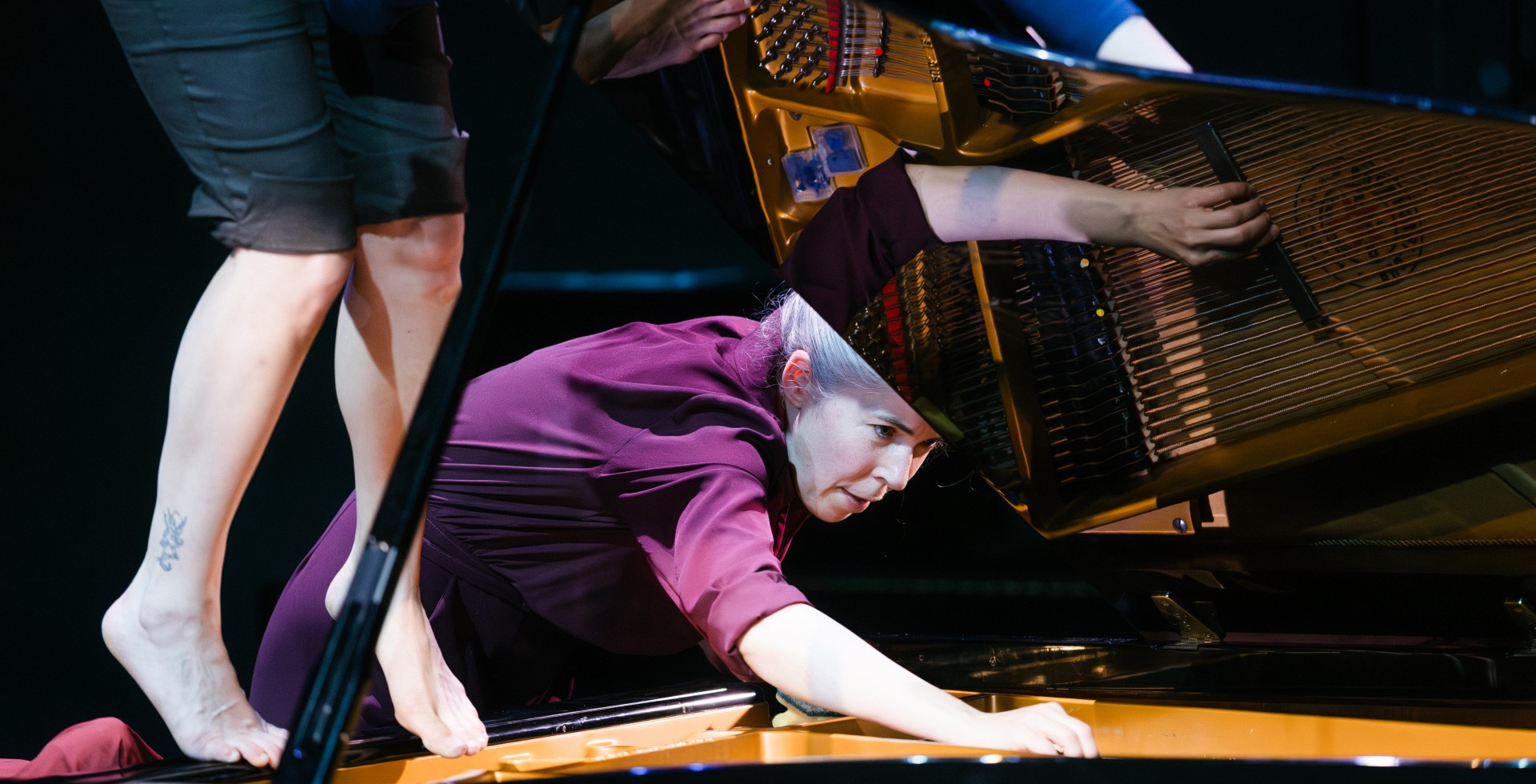
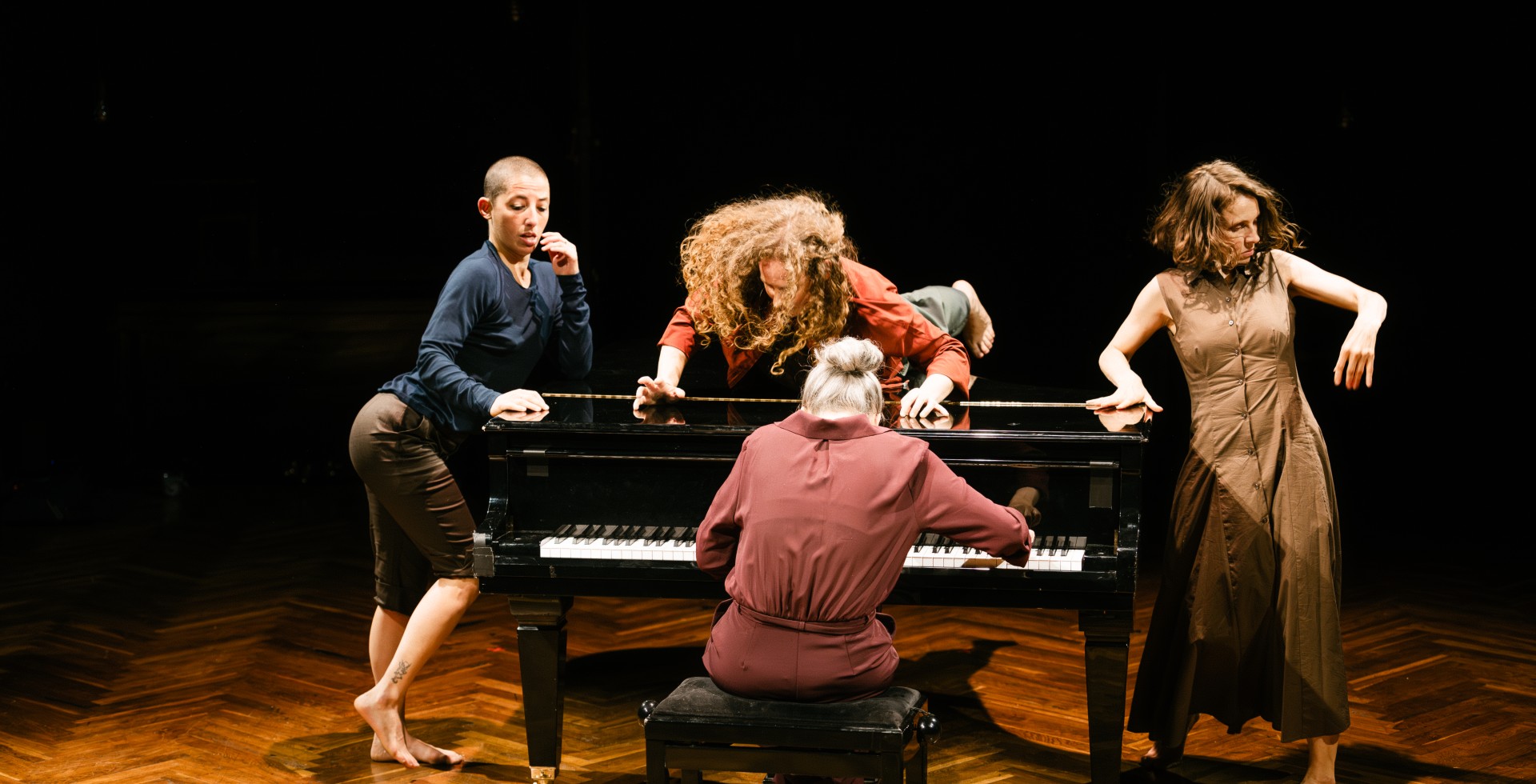
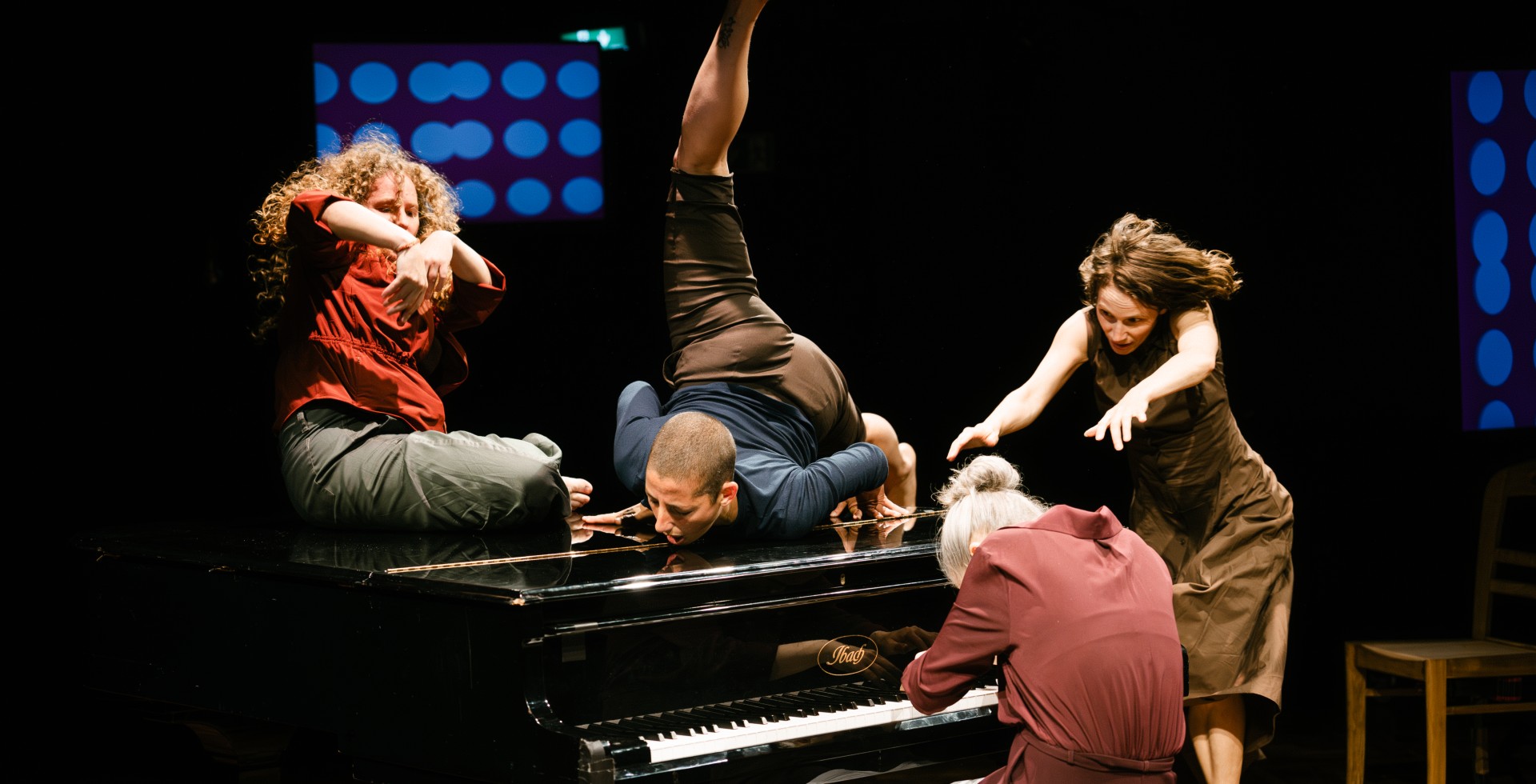
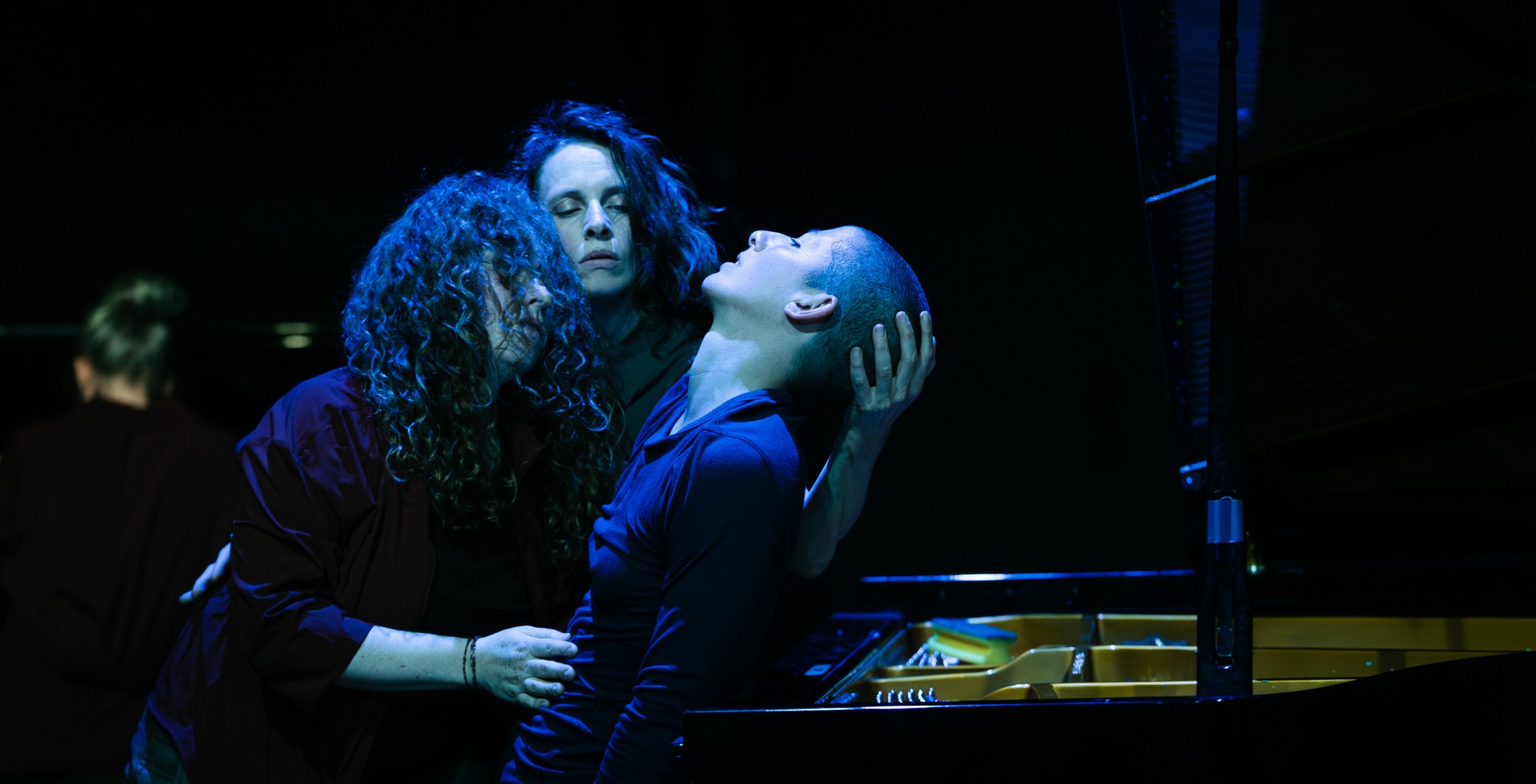
“Hidden Heartache” reflects on the experience of music from a non-hearing perspective and asks where does movement begin? Between a grand piano and a dancing body, between vibration and gesture, sound travels not only through air but through resonant bodies. Visual rhythms arise through the movement of two Deaf* and two hearing performers, where music and dance continuously reshape one another.
“Hidden Heartache” reflects on the experience of music from a non-hearing perspective and asks where does movement begin? Between a grand piano and a dancing body, between vibration and gesture, sound travels not only through air but through resonant bodies. Visual rhythms arise through the movement of two Deaf* and two hearing performers, where music and dance continuously reshape one another. At what point does dance become music, and music becomes dance?
Created by the Swiss collective ox&öl in collaboration with choreographer Lee Méir, the piece is conceived as a mixed ensemble of Deaf and hearing performers from the outset, an approach that is also reflected in its compositional aspects by bringing together Deaf and hearing perspectives within the music itself. It uses body-sound transducers to make music physically tangible. Compositions by Ailís Ní Ríain and Julie Herndon, approached from Deaf and hearing compositional perspectives, unfold through moving bodies. “Hidden Heartache”opens a shared sensory field in which listening becomes a full-body experience, and music reveals itself as a choreography of resonance.
* ‘Deaf’ (written with a capital letter) is the positive self-designation commonly used in English by people who cannot hear – regardless of whether they are deaf, have residual hearing or are hard of hearing.

A music theatre piece in body language
“Hidden Heartache” reflects on the experience of music from a non-hearing perspective and asks where does movement begin? Between a grand piano and a dancing body, between vibration and gesture, sound travels not only through air but through resonant bodies. Visual rhythms arise through the movement of two Deaf* and two hearing performers, where music and dance continuously reshape one another. At what point does dance become music, and music becomes dance?
Created by the Swiss collective ox&öl in collaboration with choreographer Lee Méir, the piece is conceived as a mixed ensemble of Deaf and hearing performers from the outset, an approach that is also reflected in its compositional aspects by bringing together Deaf and hearing perspectives within the music itself. It uses body-sound transducers to make music physically tangible. Compositions by Ailís Ní Ríain and Julie Herndon, approached from Deaf and hearing compositional perspectives, unfold through moving bodies. “Hidden Heartache”opens a shared sensory field in which listening becomes a full-body experience, and music reveals itself as a choreography of resonance.
* ‘Deaf’ (written with a capital letter) is the positive self-designation commonly used in English by people who cannot hear – regardless of whether they are deaf, have residual hearing or are hard of hearing.
Composition:
AILÍS NÍ RÍAIN, JULIE HERNDONChoreography, co-creation and costume design:
LEE MÉIRConcept:
OX&ÖLStage direction:
PHILIP BARTELSDramaturgy:
STEPHANIE MÜNDEL-MÖHRProduction management:
ARIANE RUSSIPerformance:
ELI COHEN, LUA LEIRNER, SIMONE KELLER, KASSANDRA WEDELA co-production of the Münchener Biennale and ox&öl.
In cooperation with HochX Theater und Live Art.
Commissioned by the City of Munich for the Münchener Biennale for composition and libretto, with the kind support of the Forberg-Schneider-Stiftung
With the kind support of: Stadt Zürich Kultur, Pro Helvetia, and the Ernst Göhner Stiftung




Hidden Heartache – a music theatre in body language
“Hidden Heartache” emerged from an extended artistic research process at the intersection of music, translation, and perception. The starting point was the publication “Hidden Heartache” by pianist Simone Keller, which brings together a 100-minute piano compilation and a book of essays reflecting on social inequality in music history. Rather than treating this material as an archive, the music theatre project continues it as a live, embodied investigation: how historical and conceptual questions about exclusion and access can become present in performance.
From the beginning, the work was shaped by the conviction that music is not a universal language. The idea that music can be understood in the same way by everyone is questioned throughout the process. Musical perception is culturally, historically, and individually formed; it differs not only between societies, but also between bodies, sensory experiences, and modes of attention. In “Hidden Heartache”, music therefore does not function as a shared code, but as a field of multiple, sometimes conflicting, forms of perception.
“Hidden Heartache” reflects on the experience of music from a non-hearing perspective and asks: where does movement begin? Between a grand piano and a dancing body, between vibration and gesture, sound travels not only through air but through resonant bodies. Visual rhythms emerge through the movement of the performers, where music and dance continuously reshape one another. At what point does dance become music, and music become dance?
The work emerged over a long, processual period within the collective ox&öl, in which it was crucial from the outset to bring together Deaf* and hearing perspectives not as opposing positions, but as equally valid and distinct ways of perceiving. Rather than aiming for a unified language or translating one experience into the other, the process was shaped by the decision to let multiple forms of perception exist alongside each other and to allow them to influence the work without being resolved into one system.
A central role in this process was the collaboration between pianist Simone Keller and the composers Ailís Ní Ríain and Julie Herndon. Working in parallel, they brought different sensory and artistic perspectives into the material: a Deaf and a hearing perspective, not as fixed categories, but as lived and situated approaches to sound, body, and attention. It was important that these perspectives were not merged or harmonized, but remained in productive tension throughout the development.
At the same time, the performers Eli Cohen, Lua Leirner, and Kassandra Wedel, together with choreographer Lee Méir and director Philip Bartels, were deeply involved in shaping the piece. In this collective process, composition, choreography, and performance are not separate layers but continuously interwoven. The work does not assume a shared way of experiencing, but creates a space in which different perceptual realities can coexist.
At its core, “Hidden Heartache” is not about creating a shared language. It is about sustaining a shared space in which different perceptual worlds can remain distinct while still relating to one another. What emerges is a fragile, constantly shifting form of togetherness – one that acknowledges that understanding is never complete, and that meaning always remains partially out of reach.
* ‘Deaf’ (written with a capital letter) is the positive self-designation commonly used in English by people who cannot hear – regardless of whether they are deaf, have residual hearing or are hard of hearing.
Titles and notes on the musical pieces featured in the show
Ailís Ní Ríain:
excerpt of “Into the Sea of Waking Dreams” (2007)
A suite of short pieces which ruminate on the in-between states of restless awakeness and a dream state. The four pieces are accompanied by optional text which may be spoken, whispered, sung or meditated upon as part of the performance.
Ailís Ní Ríain: “Beautiful Cracked Eyes” (2008)
An episodic work suggesting 10 miniature ‘scenes’. The title is taken from a poem by the Irish poet Pat Ingoldsby – for him, the people with ‘beautiful cracked eyes’ were those who had lived lives of difficulty and disappointment and who possess a hard-won wisdom. The people with ‘beautiful cracked eyes’ are often excluded from general society, they live on the margins, they are the desperate ones.
Ailís Ní Ríain: “Anomaly” (2019)
A very short work for toy piano. An anomaly is something that deviates from what is standard, normal, or expected; it is an abnormality, irregularity, or inconsistency. Often described as a “blip” in a pattern.
Ailís Ní Ríain: “Hidden Heartache” (world premiere) (2026)
“Hidden Heartache” is a new work for piano and fixed audio media. The composer plays the recorded piano and Simone Keller, the live pianist, responds in real-time to a series of altered and prepared piano provocations. The entire focus is on the performer’s ability to listen, mimic and mirror in real-time. The resulting piece is an eerie duet between a deaf composer-pianist and a hearing live performer. The piece gives the performer agency to respond differently to each iteration of the ‘fixed’ and to acknowledge the absolute gift they possess - the ability to listen and interpret sound with and thorough their whole bodies.
Ailís Ní Ríain/Claude Debussy: “The Height of Me” (2018)
This work was commissioned to follow the opening minute of Debussy’s original material – an intriguing proposition. The piece is based on “Les soirs illuminés par l’ardeur du charbon,” which is considered Debussy’s final piece of piano music. The manuscript surfaced in 2001 and apparently was given by Debussy to his coal merchant in lieu of payment during the harsh wartime winter of 1916-1917. The title is a line from Baudelaire’s “Le balcon”.
Julie Herndon: “Heart” (world premiere) (2026) for video, light, and piano
“Heart” explores how internal biorhythms become shared experience. It uses pulse and breath – rhythms we all feel – to synchronize gestures that resonate through the ensemble. These intimate rhythms unfold as counterpoint, moving outward from the body into a shared space.
Movement, sound, and light all originate from the same energetic source, unfolding at different speeds and intensities. Sound triggers light, movement shapes video, and breath becomes a visible and kinetic force. These layers emerge from the texture as distinct voices.
The piano and light bulb videos offer alternate perspectives of the actions on stage, bringing the audience closer to the musical and choreographic gestures that animate the piece. Small actions are expanded on the screen: a piano hammer striking the strings, fingers on keys, a light bulb illuminating.
The sound-responsive light bulbs – part of a Lightbox instrument I created with John Ivers – translate pitch and intensity into shifting visual patterns, extending the performers’ actions in direct and unpredictable ways. The bulbs flicker, pulse, and glow in response to the intensity of movement and sound. While some correlations are fixed, the system maintains an intrinsic variability and independence that invites a heightened sense of attention and curiosity.
About Julie Herndon
Julie Herndon (California, U.S.) is a composer, performer, and sound artist whose interdisciplinary work explores the relationship between body, sound, and technology. Her work invites listeners into intimate, unpredictable sonic worlds—described by San Francisco Classical Voice as “surprisingly expressive.” Herndon’s work has been presented internationally at festivals and venues including National Sawdust (New York), Musica Nova Helsinki, and Música Estranha (Brazil). Recent collaborations with andPlay and [Switch~ Ensemble] investigate the interplay between social, environmental, and musical ecologies. Herndon is currently Assistant Professor of Music Technology and Composition at Cal Poly.
About Ailís Ní Ríain
Ailís Ní Ríain is female Irish classical composer whose work has been commissioned, performed, recorded and broadcast worldwide. She has been commissioned by the BBC Philharmonic, RSO Wien, Musikfabrik, London Sinfonietta, Ulster Orchestra and New Music Dublin. She has been awarded the prestigious Paul Hamlyn Award for Composers.
Her artistic interests include concert music, installation and music-theatre. A portrait disc of her work was released by NMC Recordings in 2023 to considerable acclaim. Ailís is deaf/hard of hearing and a long-time advocate for better representation and access in music.
Podcast Transcript: Ailís Ní Ríain in conversation with Bastian Zimmermann
Podcast-Transkript „Noch nicht Premiere“ (gekürzte Fassung)
Bastian Zimmermann: Noch nicht Premiere. Der Podcast der Münchner Biennale für Neues Musiktheater. Und nun ist es schon die fünfte und letzte Folge unserer kleinen Podcastreihe Noch nicht Premiere. Heute treffe ich tatsächlich das erste Mal eine Person nicht live, sondern online. Es ist die irische Komponistin Ailís Ní Ríain, die das Stück „Hidden Heartache“ zusammen mit mehreren Musikerinnen und Tänzerinnen und auch der Komponistin Julie Hurnton entwickelt hat. Sie ist schwerhörend bzw. fast taub, und deswegen hilft uns die Online-Situation mit einer Live-Transkription, die sie lesen lässt, was ich zu ihr sage. Das Gespräch ist auf Englisch, und ja, danach sehen wir uns dann wahrscheinlich ganz bald auf der Biennale für neues Musiktheater.
Thank you for having me here, like meeting me, Ailís. Like we know each other from before already, and I'm very happy that you will be part in this Munich Biennale for New Music Theatre. Yeah, like your piece, or not only your piece, but like of a whole team, is called “Hidden Heartache”. Can you maybe talk a bit about the piece, how it happened, how it evolved? And yeah, I don't know what the initial point was to start the project?
Ailís Ní Ríain: Sure. The starting point was Simone Keller's album. Simone is the pianist and music performer in the production. She released an album and a book publication in 2024 called Hidden Heartache, which is also the name of the show in English. And the theme of that book and that recording was to explore social inequality in music history. I think she wanted to develop that work further and she wanted to look beyond, I think, those forms as they represent an archive, I guess, but wanted to create something that had a live performative format that's drawing heavily from her research and outcomes in those materials. I also think a key influence for her and the background to this work was the essay which is called My Life as a Twin by Sandra Hetzel, and that introduces ideas of split identity and alternative selves, and crucially for us in this work also, the idea of translation. And then from that, I think a centralist issue, sorry, a central interest started to emerge, which was around translation as both an artistic and indeed a political act. When we're thinking of translation in regard to language, music, bodies, and of course, really crucially, perception.
So, from the very beginning of the project, it was clear that it should be inclusive as practice. So not just a theme of inclusion, but bringing together Deaf and hearing performers and director collaborators, choreographers, dramaturg, and dancers.
Bastian Zimmermann: Amazing. Like, I'm curious about these, yeah, what these translations can be. And I mean, we are already like, we are talking now also in a translation setting for the ones who listen to the podcast, you read transcription, the live transcription of my words and answer to them. So happy that we have this technique. Can you tell a bit more about this, the actual piece? Like, what can I imagine or what will happen?
Ailís Ní Ríain: Well, Hidden Heartache is a music theater piece. And I guess somewhat unusually, it's in body language. So there's no linear narrative as such. But the piece really is a process of searching for a mutual understanding. And it's back to this idea of translation again, because before deaf— because for deaf people, translation and communication and interpretation is the core aspect of our day-to-day how we work in the world. So for us, we are constantly trying to translate, trying to understand, trying to decipher what people mean and also what isn't being said. So there's a great number of things occurring simultaneously. And in this work, we have two deaf and two hearing performers, both of them simply encounter each other in the stage space. And from those misunderstandings, um, dependencies, and then moments of connection gradually unfold. So the space then becomes a place where music and movement and perception continuously transform into each other. And then we also have what we're referring to as a utopian layer, and that's the attempt to imagine a form of communication which is beyond translation, which brings us back to the idea of body language.
Bastian Zimmermann: And so there are now 4 performers, and one of the performers is Simone Keller also, the musician you mentioned where the inspiration came from. So I imagine a bit more, how to say, complex composition process, not only you sitting at the desk and writing notes down, but can you tell a bit about how you developed the piece and the translations with the performers, with you, like choreographers or the directors?
Ailís Ní Ríain: Absolutely. Well, communication is always essentially connected and entangled with power structures. And no more is this clearer than when it comes to a composer and a performer, who holds the power in that situation? And also, when you behold a deaf and hard of hearing, or a deaf or hearing person, again, it comes back to power structures. Who has the ability? Who has the capacity to understand, and effect change in that kind of relationship. So when it came to the composition process, I wanted to look at this quite differently to how I normally work, because there's quite a team of us and people are coming from very different positions. So we have performers here working in Swiss German, in German, in Portuguese. So on the face of it, people are already speaking in different vocal languages, and then we have sign language, and then we have the physical language and composition. So I wanted to create a work which itself was focused on active listening. So we have a company of deaf and hearing performers, and for me, instead of providing a notated score, which for me is what is given, what's the expected with a composer, I guess, I wanted to try and do something different where I asked the question, what is listening?
And of course, what I don't know is what listening is for a hearing person. I know what listening is for me, but I don't know what it's like in this case for Simone Keller, the musician at the heart of the piece. So I wanted to create a piece that actually puts the focus on her ability to listen, because that is what I don't have in the production, and two of our performers also don't understand the world through a hearing perspective. So in this production, I think it's also kind of crucial to understand that composition is not understood purely as writing music, but as the collective process between the sound, body, and the stage. So it's a number of things coming together. The works in that case then are not simply performed because they're coming from a different place entirely to begin with. So we're looking at material, information, sound, gesture, and it is reinterpreted and then transformed and ultimately redistributed within the ensemble and then to our audience.
Julie Herndon about “Hidden Heartache”
“Hidden Heartache” is about to premiere. Was there a particular moment during rehearsals that has stayed with you?
The most impactful moment for me was seeing the first full run-through. The way sound, choreography, staging, and lighting came together was striking. Each element clearly carried the imprint of the collaborators who shaped it, while at the same time forming a cohesive artistic statement.
How did the collaboration with the collective ox&öl come about, and what drew you to working together on this project?
I first worked with ox&öl and dancer Lua Leirner who is also part of „Hidden Heartache”, on a 2021 project called “Extensions”. It remains one of my favorite projects I’ve been involved in. Philip (Bartels) and Simone (Keller) are deeply thoughtful collaborators who always approach the work holistically. “Extensions” was based on the journal entries of Enno Park, a self-described “cyborg,” writer, and philosopher who lost his hearing and later received a cochlear implant. Composing for that piece was my first experience writing for deaf performers and audiences. Working with Lua and the Deaf community in Zurich taught me a great deal about different ways of perceiving movement and sound, and that experience continues to shape my work.
In “Hidden Heartache”, movement seems to function not only as expression, but also as a starting point for the music and vice versa. What roles do the body, movement, or spatial dynamics play in your own compositional process?
For me, sound is movement: bodies resonating in space. My music is therefore inherently theatrical, with a strong focus on the relationships between performers and their physical actions.
How do you experience the interplay between your compositions and Ailís Ní Ríain’s work within a shared music theatre evening?
Philip (Bartel) and Lee (Méir) have done a beautiful job of connecting Ailís’ work and mine through choreography, staging, and direction. Although the pieces are quite different, we share an approach to the piano that invites performer interaction and spontaneous response, creating a meaningful dialogue and sense of connection between them.
Is there something you discovered about your own compositional practice through working on “Hidden Heartache”?
This process reminded me how much I value being present in rehearsals. My favorite part of composing is trying things out live and responding to what happens in the room. I especially enjoyed working closely with the performers to shape the piece in real time.
AILÍS NÍ RÍAIN
Composition

JULIE HERNDON
Composition
OX&ÖL

PHILIP BARTELS
Stage direction

LEE MÉIR
Choreography
FRI
15.05.19:15
SAT
16.05.16:15
SUN
17.05.11:15
Hidden Heartache: Was gibt's? HochX Theater und Live Art
45 Minuten bevor der erste Ton erklingt, fragen wir gemeinsam „Was gibt’s?“ und geben Ihnen erste Einblicke in die Musiktheaterproduktion „Hidden Heartache“.
SAT
16.05.18:45
SUN
17.05.13:45