world premiere
ENDLICH
ASIA AHMETJANOVA
A musical theatre production by Asia Ahmetjanova and Franziska Angerer
Three Norns sit at the foot of the World Tree. There they spin, knot and cut the thread of life, deciding on who lives or dies. In a present where end-of-life has become the greatest social taboo, the battle to halt physical decline and the ageing process becomes a life's work.
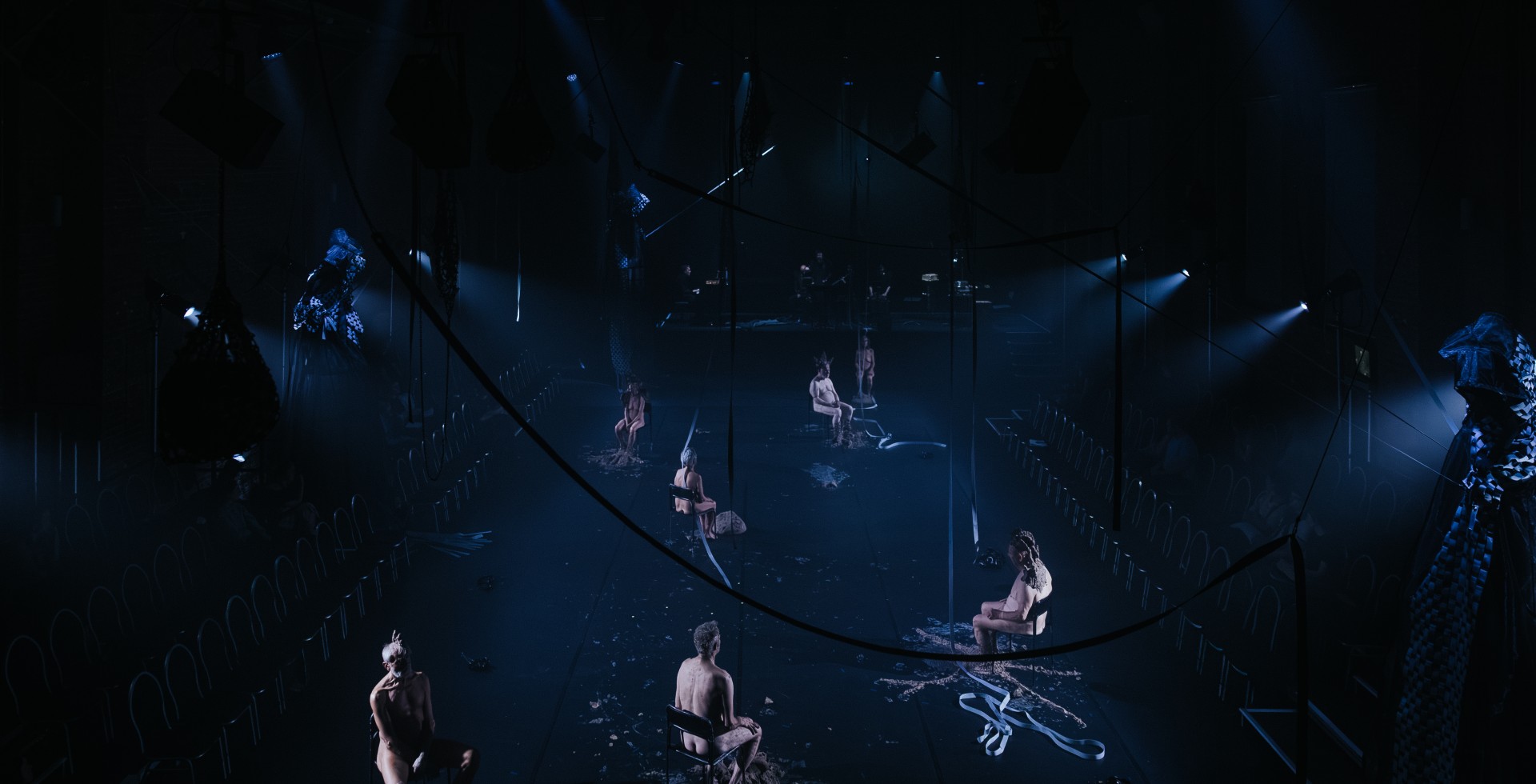
Three Norns sit at the foot of the World Tree. There they spin, knot and cut the thread of life, deciding on who lives or dies. In a present where end-of-life has become the greatest social taboo, the battle to halt physical decline and the ageing process becomes a life's work. In their musical theatre piece “ENDLICH” (FINALLY), composer Asia Ahmetjanova and director Franziska Angerer dare to confront the inevitable. Working with a group of elderly people, they look at their own mortality and ageing with all its attributions. The result is a shared ritual that lies between mythology and performance and faces up to the final consequence of life.
This production contains nudity throughout. Please also note that strobe lights and flashing light effects will be used during the performance. This may trigger epileptic seizures or migraines in people who are sensitive to light.
SUN
10.05.
15:00
— 16:00
MON
11.05.
20:00
— 21:00
TUE
12.05.
20:00
— 21:00
A musical theatre production by Asia Ahmetjanova and Franziska Angerer
Three Norns sit at the foot of the World Tree. There they spin, knot and cut the thread of life, deciding on who lives or dies. In a present where end-of-life has become the greatest social taboo, the battle to halt physical decline and the ageing process becomes a life's work. In their musical theatre piece “ENDLICH” (FINALLY), composer Asia Ahmetjanova and director Franziska Angerer dare to confront the inevitable. Working with a group of elderly people, they look at their own mortality and ageing with all its attributions. The result is a shared ritual that lies between mythology and performance and faces up to the final consequence of life.
This production contains nudity throughout. Please also note that strobe lights and flashing light effects will be used during the performance. This may trigger epileptic seizures or migraines in people who are sensitive to light.
Composition:
ASIA AHMETJANOVAConcept:
FRANZISKA ANGERER, CAROLIN MÜLLER-DOHLEMusical direction:
LEONARD WEISSStage direction:
FRANZISKA ANGERERStage and light design:
MIRJAM STÄNGLCostume design:
SABRINA BOSSHARDAssistant stage director:
ELLI NEUBERTSound direction:
ARNE VIERCKDramaturgy:
CAROLIN MÜLLER-DOHLE, SEBASTIAN HANUSAMezzo-soprano:
CONSTANZE JADERMezzo-soprano:
LANA MALETIĆCountertenor:
JENS GINGE SKOVPerformance:
ANTON KAZDA, HEIDI KRAUSE-KOHM, WAKI, ARMIN DALLAPICCOLA, EDELTRAUT LETTOW, ZIV FRENKEL, ALEXANDER NAGELENSEMBLE MOSAIK
Violin:
SARAH SAVIETFlute:
KRISTJANA HELGADOTTIROboe:
SIMON STRASSERTuba:
JACK ADLER-MCKEANPercussion:
ROLAND NEFFEPiano, keyboard:
ERNST SURBERGCo-production by Münchener Biennale and Deutsche Oper Berlin.
Composition commissioned by the City of Munich for the Münchener Biennale with friendly support of pro helvetia and Gisela-Gronemeyer-Stiftung.

CLAY, RITUAL AND THE GAME
Thoughts on “ENDLICH”, music theater by Asia Ahmetjanova und Franziska Angerer
The mother goddess Aruru created the wild man Enkidu from clay, and he crumbled back to clay after enduring an excruciating death lasting fourteen days - his punishment for slaying the celestial bull – and was mourned by his friend Gilgamesh. In the Judeo-Christian tradition, God creates Man out of clay, makes him mortal by expelling him from the Garden of Eden with the words: “From dust you are, and to dust you shall return”. In countless myths of creation clay, earth and dust, combined with water, are not only the basis of all plant life but equally those building blocks of humankind into which we will all decay and decompose after death – to then become humus for new life. Thus, clay symbolizes the integration of humankind into the cycle of birth and decay of all living beings – and as such, has found its way into the mythological traditions of numerous cultures.
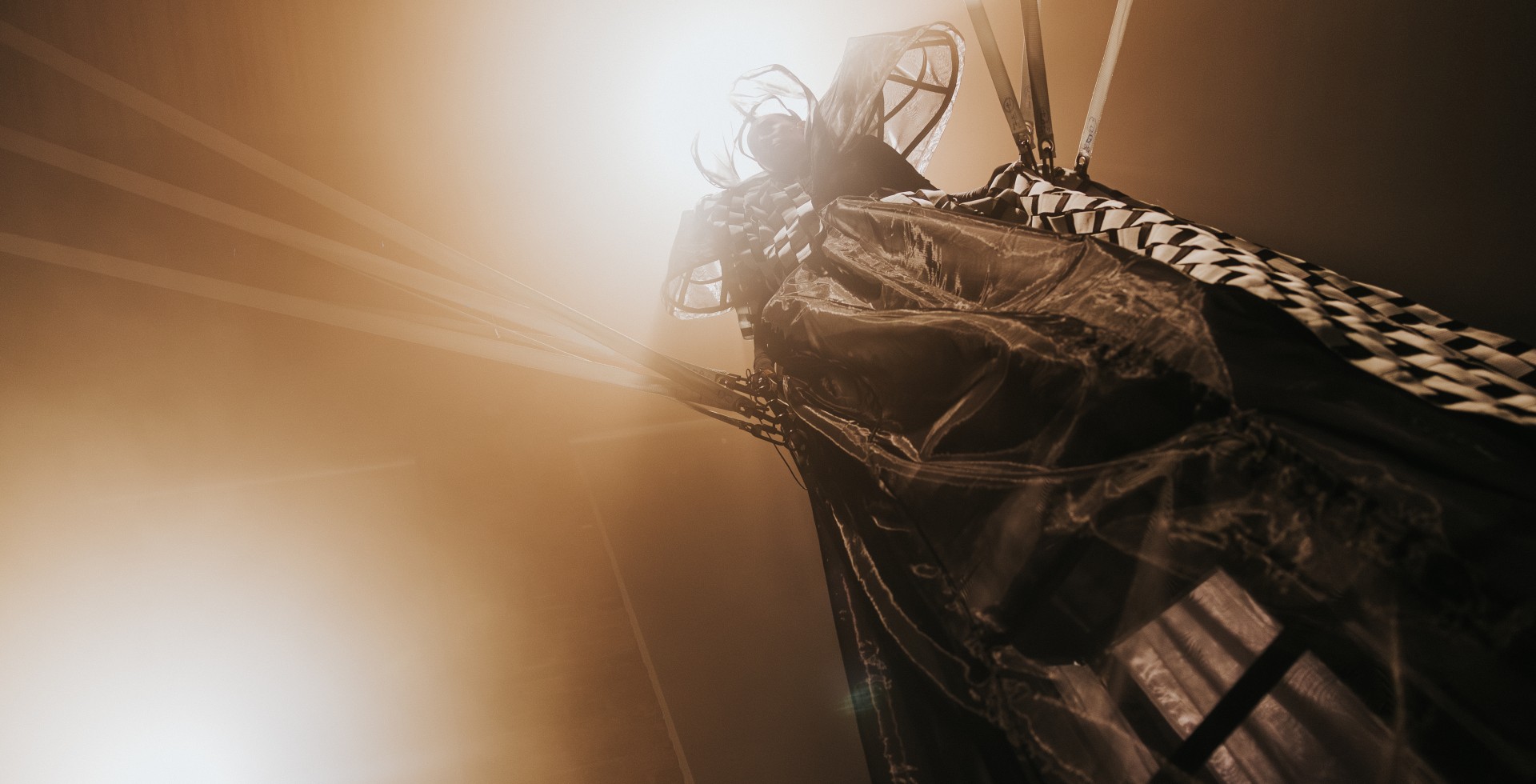
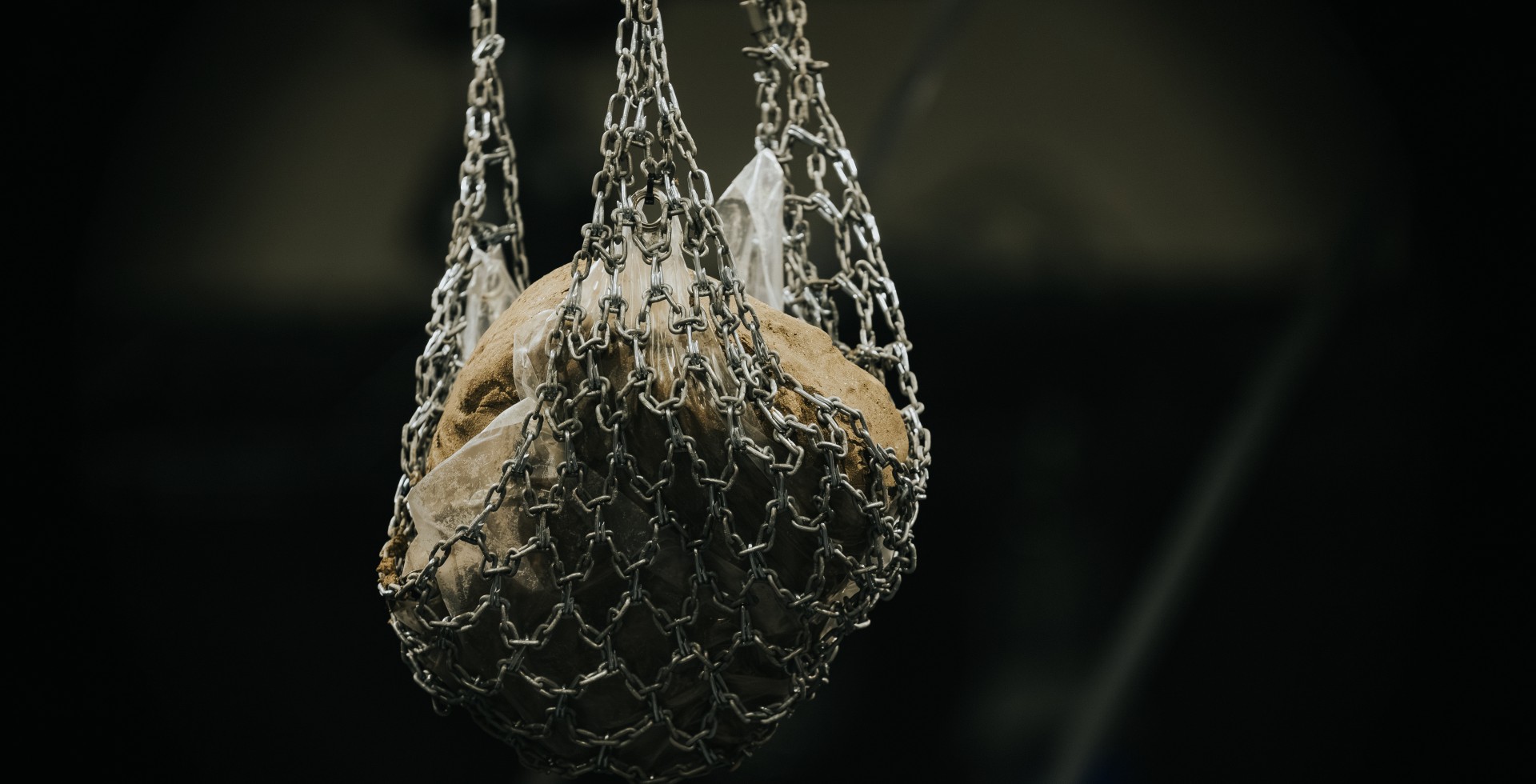
At the same time, however, clay is the prerequisite for humankind’s development as cultural beings. The peoples of the Sumerian civilization settled down on the fertile alluvial plains of Mesopotamia and began to practice agriculture. They built their cities from clay, wrote the earliest known human script on clay tablets, and fashioned the weights for their looms from clay to produce fabrics and cover their naked bodies with clothing. In this dual sense, clay is a central material in the music theatre piece “ENDLICH” by composer Asia Ahmetjanova and director Franziska Angerer: seven people, at the end of their lives, naked as they were when they first came into the world, take to the stage. One by one, they exit the performance and are covered in clay. Simultaneously, clay becomes the malleable substance of Homo faber: as a material shaped by humans through playful kneading and molding, but also, in Mirjam Stängl’s set design, as weights hanging from the ceiling in a spatial installation inspired by the idea of a large loom. The threads of this “loom” converge on three Norns, two mezzo-sopranos and a countertenor, and consequently on three characters inspired by the Norns of Norse mythology, who sing Old Icelandic texts from the Völuspá, a part of the Edda — and who represent ideas found in numerous cultures and traditions. They decide who may take part in the Game of Life and who must be ruled out. Despite their omnipotence, there is something lacking in their own existence. They themselves are not allowed to participate in the Game of Life but can only observe it as outsiders — and yet, as the narrative recounts, they are transient and, unlike the elderly people on stage, must leave before the curtain falls.
This idea of transience and disintegration as a concrete, structure-building approach, is also inherent in Asia Ahmetjanova’s music: the instruments of the six-piece ensemble are gradually altered in their familiar tonal characteristics through disassembly and the use of preparations, such as wool threads, and are ultimately silenced entirely. At the same time, however, the composition employs a strategy with which people, ever since the first awareness of their own transience, have played upon, sung about, danced and composed poetry to. It is the transformation of everyday language, sounds and movements into austere forms of ritual, art and play, in which they are – in part – relieved of the real world with its relentless passing of time. This is successful when they follow their own legality and are subject to their own form of temporality. One historical form for structuring ritual is the Roman Catholic Ordinary of the Mass, with its sequence of different parts, each with its own form and specific character: this serves as the organizing principle underlying the composition of “ENDLICH”. It is not intended as an engagement with Christian tradition, however, but rather stands pars pro toto for those strict frameworks through which, in both religion and art, experiential spaces are created and made possible that are separated from reality – and within which, in music theatre, breathing space opens up for Homo ludens in an interaction of restriction and freedom all of its own: for the modelling of clay, for the joyful combination of sounds and movements, for births and memories.
By Sebastian Hanusa

ASIA AHMETJANOVA
Composition

FRANZISKA ANGERER
Stage direction

MIRJAM STÄNGL
Stage design

SABRINA BOSSHARD
Costume design

ENSEMBLE MOSAIK
SUN
10.05.14:15
MON
11.05.19:15
TUE
12.05.19:15
ENDLICH: Was gibt's? Freiheitshalle
45 Minuten bevor der erste Ton erklingt, fragen wir gemeinsam „Was gibt’s?“ und geben Ihnen erste Einblicke in die Musiktheaterproduktion „ENDLICH“.
MON
11.05.21:30
TUE
12.05.21:30